
shop
...weaving the Waitaki tartan is a passion project for us...

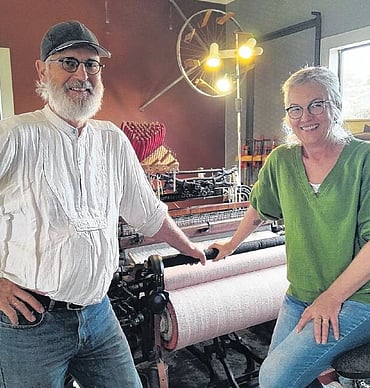
... weaving the tartan ...

We used a free online tartan generator to work out the design for our Waitaki #1 warp. As mentioned on the designing page, it took a lot of thinking about the stories we wanted to tell, and how we could do that within the limitations of our c1895 Hattersley Domestic Weaving System. We perservered, and are both really happy with the final outcome.

Following the fleece being scoured in Timaru and dyed here in Oamaru, we took it to Wild Earth Yarns in Christchurch for spinning. Wild Earth Yarns are another small woolly, family business. You can check them out at www.wildearthyarns.co.nz
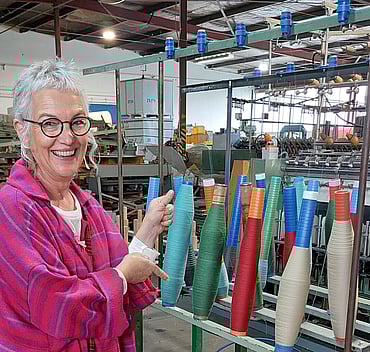
The fleece is spun into really fine yarn, and then two strands of it are twisted together to make it stronger for us to weave. There are no chemicals or special finishes used in this process, it's just natural wool dyed and spun as ecologically as possible.

In order to make a fine, clean yarn the fleece is combed multiple times, resulting in all the fine, wayward fibres being removed from the finished product. This 'wastage' is sent to be made into insulation, also in Christchurch.

Cones of our wool, grown and processed as close to home as was possible. One of the joys of being invested in a project like this, is the pleasure we get from knowing that we are supporting local, and being part of a team producing quality New Zealand textiles.
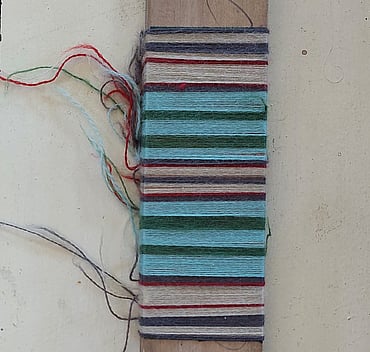
Once some yarn arrived from the wonderful team at Wild Earth Yarns in Christchurch, we were able to complete this winding. It showed us how the colours worked with each other, and we were able to make sure that our estimate of 36 ends per inch would actually work.

Our plan, sitting on the empty warping frame, waiting for the yarn to be wound off the cones and onto the bobbins.
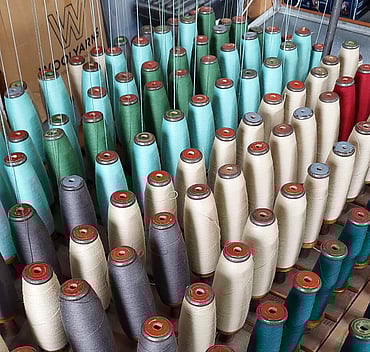
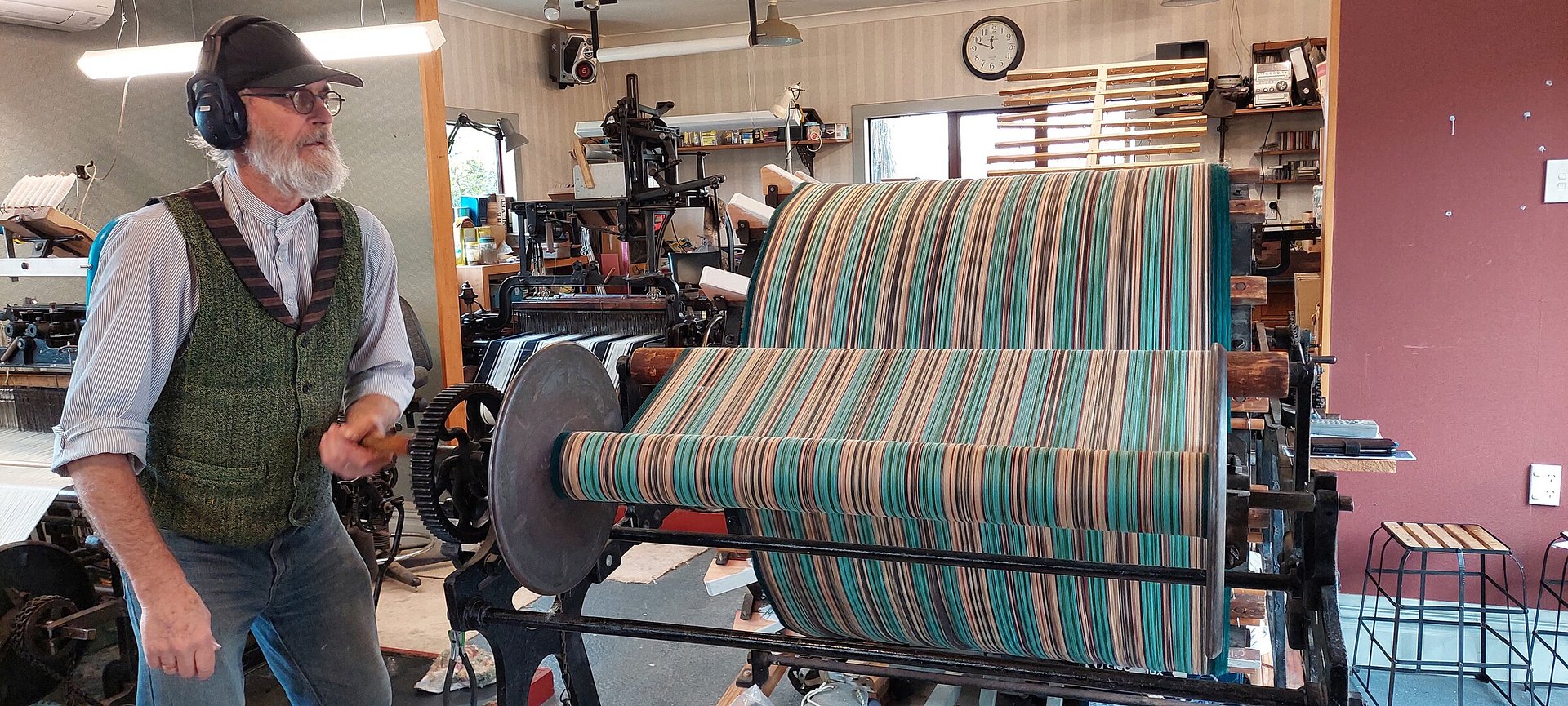
The bobbins on the warping frame, ready to be threaded through the the reeds and tensioning rollers, then wound onto the drum to complete the first section.

Here is Rod threading the ends through the reeds in preparation to being wound onto the mill. Each thread has its own gap in the first reed, and then four ends are threaded through the second reed. This is a really importand part of the process as it ensure the threads don't get crossed or tangled, and cause trouble later on during the weaving.
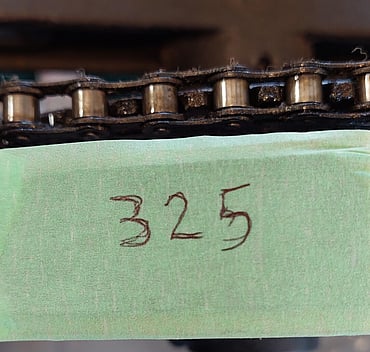
The reminder to tell Rod when to stop winding yarn on. The number on the counter has to match this, otherwise the warp will have different length sections in it. 325 should give us approximately 60 finished metres of weaving, depending on shinkage during the fulling process.


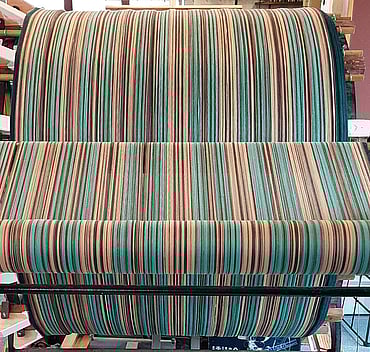
Showcasing the warp stripes as the warp is wound onto the back beam, in prepartion for threading through the heddles on the shaft. This process is called 'beaming'.
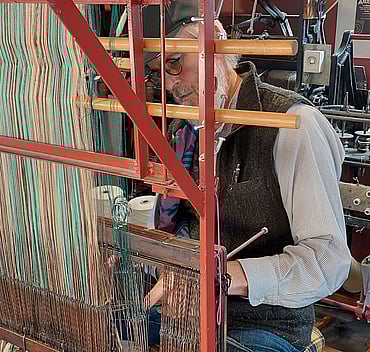
Threading each length of yarn through its own heddle on its correct shaft is a time consuming job. If you make an error and don't correct it, it will be there for the entire length of fabric.
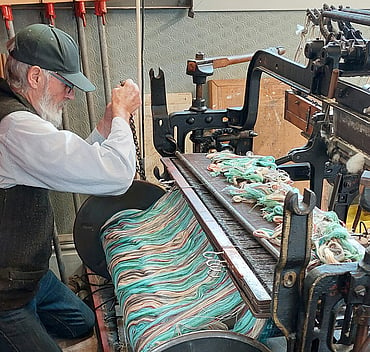
Setting the back beam, shafts and beater onto our c1895 Hattersley Domestic Dobby Loom, the only one of its age working in the world.

Approximately 40 hours after Rod first started winding the yarn off the cones onto the bobbins, everything is finally on the loom.
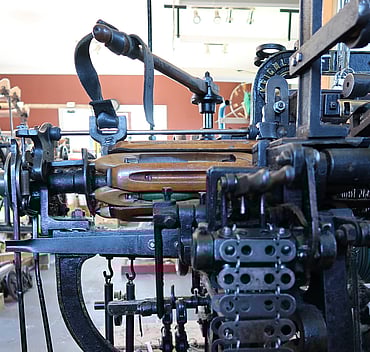
The 1895 computer system that operates the rotating shuttle box while Rod weaves. He makes up a new chain for each tartan - this is the chain for the Waitaki tartan.

This is our dobby computer system that lifts the shafts in the correct order to weave the twill design that traditional tartans are woven in. Rod makes up new chains for the different designs he weaves. We can have up to 12 shafts on this loom, but only use four for a twill.

The first few rows of weaving. At this stage Rod tunes the loom, adjusting the weights, the strength that the beater beats each row of weaving, the tensions and how the fabric rolls on as he weaves.
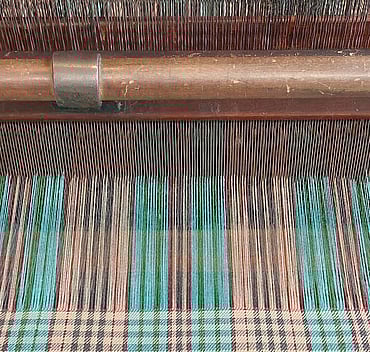

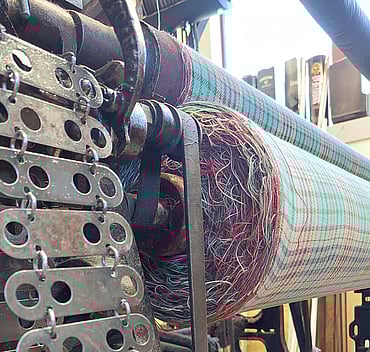

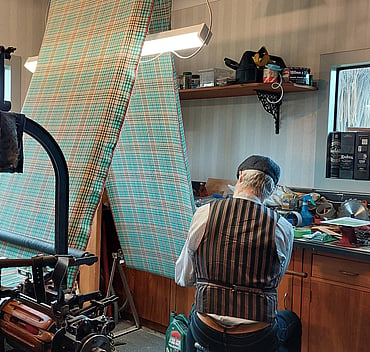
Once Rod has finished weaving the warp he spends the next few hours darning it. This involves undoing any knots and needle weaving in the ends, trimming any excess threads and noting any flaws.
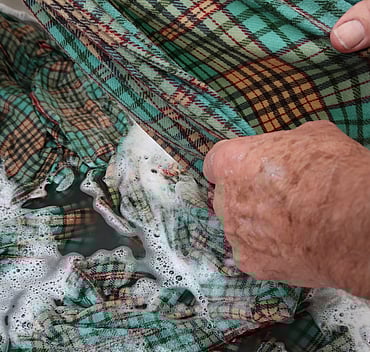
Then the length of tartan is washed, or fulled. We do this together as it's quite strenuous, especially with longer warps. We use soap flakes and warm water, no chemicals.
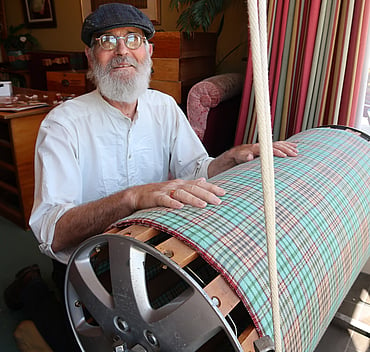
Then Rod stretches the wet fabric onto the wooden roller he made, in our lounge's bay window, so the sun can dry it. As there are no fabric finishing factories in New Zealand Rod has invented and constructed his own.

And finally, we have nearly 70 metres of finished Waitaki tartan, woven in the Waitaki by a Waitaki weaver, telling Waitaki stories. Available for purchase online and at Crafted: Waitaki Artisan Gallery, Harbour Street, Oamaru, Waitaki.
... to care for your little piece of Waitaki ...
Please wash this fine Merino wool product with care. Avoid snagging. We recommend washing
gently by hand using an eco-friendly wool detergent. Dry flat in the shade. Cool iron.
DO NOT MACHINE WASH OR TUMBLE DRY.